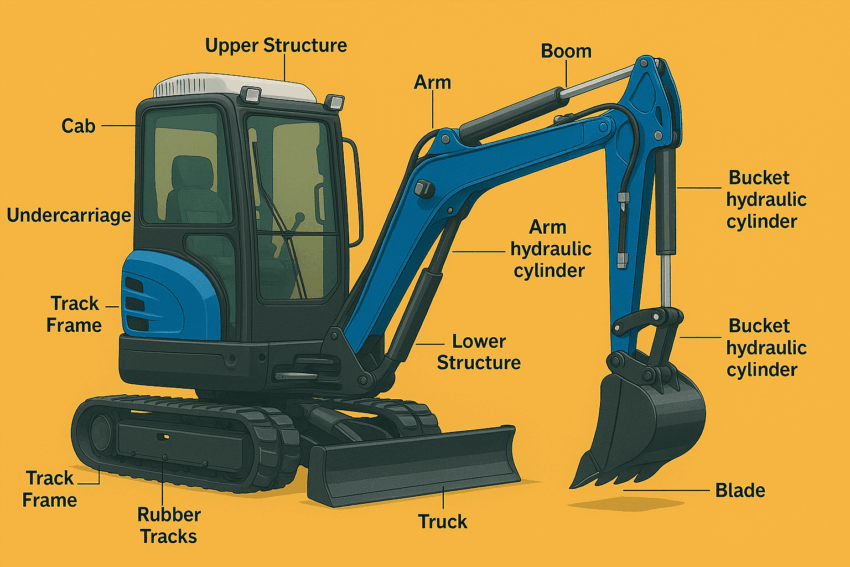
Why Mini Excavator Final Drives Matter More Than You Think
If your mini excavator suddenly loses power, starts moving slower on one side, or makes grinding noises from the undercarriage, there’s a good chance the problem lies in the final drive. It’s one of the most critical — yet most overlooked — components on any compact excavator.
Mini excavator final drives are the hydraulic motor-and-gearbox assemblies that deliver power directly to the tracks. Without them, your machine simply doesn’t move. They convert hydraulic pressure into the mechanical torque needed to rotate the drive sprockets, which in turn pull the tracks forward or backward. In short, they are the muscle behind every inch your machine travels.
Despite their importance, final drives are often ignored until they fail — and that’s where the real trouble starts. Replacing a final drive on short notice, with zero research, can cost significantly more than a planned, informed replacement. This article is designed to give you every piece of knowledge you need about mini excavator final drive systems — from how they work and why they fail, to how to choose the right replacement and extend their lifespan.
Whether you’re a contractor, rental yard operator, landscaper, or DIY mechanic, understanding your excavator final drive could save you thousands of dollars and weeks of downtime.
What Is a Mini Excavator Final Drive?
Breaking Down the Final Drive System
A mini excavator final drive is a two-part assembly consisting of:
- A hydraulic travel motor — receives high-pressure hydraulic fluid from the machine’s pump and converts it into rotational movement.
- A planetary gear reducer — takes that rotational energy and multiplies the torque while reducing speed, delivering the right amount of force to move the tracks.
Together, these two components form what most people call the “final drive” — and they sit at the very end of the machine’s power transmission chain, which is why the name makes sense. All the power generated by the engine and hydraulic system ultimately passes through the final drive before reaching the ground.
Most mini excavators have two final drives — one for the left track and one for the right track. This allows the machine to steer by driving the tracks at different speeds or in opposite directions, giving the excavator its characteristic zero-tail-swing turning ability.
Suggested read: How Long Does It Take to Drive Across Texas? Everything You Need to Know Before You Go
The Role of Planetary Gears in Mini Excavator Final Drives
The planetary gear system inside a mini excavator final drive is a mechanical marvel. It uses a central sun gear, several planet gears orbiting around it, and a ring gear on the outside — all working together to produce massive torque multiplication in a compact package.
Here’s why planetary gears are used in final drives rather than simpler gear systems:
- High torque in a small space — planetary gearsets generate far more torque than straight-cut or helical gearsets of the same size
- Load sharing — multiple planet gears share the load, reducing wear on any single gear
- Durability — the enclosed, oil-bathed design protects gears from contamination
- Efficiency — planetary systems are typically 95–98% efficient in transmitting power
The gear ratio inside a mini excavator final drive planetary system typically ranges from 20:1 to 50:1, depending on the machine’s size and design. This means the hydraulic motor spins 20 to 50 times for every single rotation of the drive sprocket — a massive mechanical advantage that allows a small motor to push a multi-ton machine through mud, gravel, and terrain that would stop a wheeled vehicle cold.
How Mini Excavator Final Drives Work: A Step-by-Step Breakdown
Understanding the operational flow of a mini excavator final drive helps you diagnose problems faster and communicate more clearly with mechanics or suppliers.
Step 1: Engine Powers the Hydraulic Pump
The diesel engine drives the hydraulic pump, which draws hydraulic fluid from the reservoir and pressurizes it to levels ranging from 3,000 to 5,000 PSI on most mini excavators.
Step 2: Hydraulic Fluid Reaches the Travel Motor
When the operator pushes the travel levers or pedals, directional control valves open and route high-pressure hydraulic fluid to the travel motors embedded inside each mini excavator final drive assembly.
Step 3: The Travel Motor Spins
The hydraulic motor converts fluid pressure and flow into rotational force (torque). Most travel motors used in mini excavator final drives are axial piston motors, known for their high efficiency and smooth operation across a wide range of speeds and pressures.
Suggested read: Hit by a Drunk Driver? Here's Everything You Need to Know to Protect Yourself
Step 4: The Planetary Gearbox Multiplies Torque
The motor’s output shaft connects to the sun gear of the planetary gearbox. The planet gears spin around the sun gear, driving the ring gear (or output carrier), which is connected to the drive sprocket. The result is low-speed, high-torque rotation perfect for moving heavy tracks.
Step 5: The Drive Sprocket Moves the Track
The drive sprocket engages the track links and pulls the rubber or steel track around the undercarriage, propelling the machine.
Types of Mini Excavator Final Drives
Not all mini excavator final drives are built the same. Understanding the different types helps when selecting a replacement.
OEM Final Drives
Original Equipment Manufacturer (OEM) final drives are built specifically for your machine model by the original manufacturer (Kubota, Bobcat, Caterpillar, Yanmar, Takeuchi, etc.). They offer a perfect fit and guaranteed compatibility but often come at a premium price — sometimes 30–60% more than aftermarket alternatives.
Aftermarket Final Drives
Aftermarket mini excavator final drives are produced by third-party manufacturers to match OEM specifications. Quality varies widely between suppliers. High-quality aftermarket units use the same or equivalent materials and tolerances as OEM parts and can offer significant cost savings without sacrificing reliability.
Pro Tip: When choosing aftermarket mini excavator final drives, look for suppliers that provide ISO certification, warranty coverage, and pressure-tested units.
Remanufactured Final Drives
Remanufactured (or “reman”) final drives for mini excavators are rebuilt OEM cores that have been disassembled, inspected, and rebuilt with new seals, bearings, and worn components. They offer a middle ground between OEM cost and aftermarket pricing, and are often a great choice for older machines.
Suggested read: Royal Drive: Everything You Need to Know About This Premium Residential Experience
Used Final Drives
Used mini excavator final drives carry the most risk — you don’t know their true condition or usage history. However, for older machines where new parts are discontinued, used units may be the only option. Always request usage hours and pressure test results when buying used.
Common Signs Your Mini Excavator Final Drive Is Failing
Catching a failing mini excavator final drive early can save you from a complete breakdown in the field. Here are the most reliable warning signs:
1. Loss of Tracking Speed or Power on One Side
If your mini excavator is pulling to one side or one track is noticeably slower than the other, one of your final drives may be losing hydraulic efficiency. This is one of the earliest and most common signs of internal wear.
2. Unusual Noises from the Travel Motor Area
- Grinding or metal-on-metal sounds — often indicate bearing failure or gear damage inside the planetary gearbox
- Whining or high-pitched noise — may signal cavitation in the travel motor, often caused by low oil or a clogged suction line
- Clunking during travel — could indicate chipped or damaged gear teeth
3. Oil Leaks Around the Final Drive
Gear oil leaking from the final drive housing is a serious warning sign. Mini excavator final drives rely on a sealed oil bath to lubricate the planetary gears. When seals fail, oil escapes, lubrication drops, and gear wear accelerates dramatically.
4. Machine Travels Slower Than Normal
A significant drop in travel speed — especially if it occurs gradually over time — often indicates internal leakage within the travel motor. Worn piston seals allow hydraulic fluid to bypass the pistons rather than doing work, reducing efficiency and speed.
5. Overheating of the Travel System
Excessive heat in the hydraulic travel circuit, indicated by warning lights or unusually warm hydraulic lines near the final drive, can signal internal bypass or low gear oil levels in the planetary section.
6. Difficulty Climbing Grades
If your mini excavator struggles to climb slopes it used to handle easily, the final drive’s torque output may be compromised — a sign of either motor wear or planetary gear damage.
Suggested read: Tennessee Driver's License Renewal Online: Everything You Need to Know for 2025
Mini Excavator Final Drive: Failure Causes and Prevention
Top Causes of Mini Excavator Final Drive Failure
| Cause | Description | Prevention |
|---|---|---|
| Contaminated gear oil | Water or debris enters through worn seals, contaminating the oil and causing gear scoring | Check seals regularly; change oil per schedule |
| Low gear oil level | Running the final drive without adequate lubrication destroys gears rapidly | Check oil level monthly; look for leaks |
| Over-speeding the motor | High-speed no-load spinning wears motor internals | Avoid high-speed spinning without ground engagement |
| Cavitation | Air bubbles in hydraulic fluid collapse violently inside the motor, pitting surfaces | Keep hydraulic fluid clean and at proper level |
| Contaminated hydraulic fluid | Dirt or water in the hydraulic system damages motor seals and pistons | Change hydraulic fluid and filters per schedule |
| Excessive side loads | Operating on steep cross-slopes overloads the drive bearings | Avoid extreme side-hill operations |
| Impact damage | Striking rocks or obstacles can crack housings or break gears | Operate carefully on rocky terrain |
| Age and wear | Normal wear accumulates over thousands of operating hours | Plan for periodic inspection after 1,500+ hours |
How to Extend the Life of Your Mini Excavator Final Drives
Following a disciplined maintenance routine is the single best investment you can make in the longevity of your mini excavator final drives. Here are the most important steps:
- Check gear oil level every 250 hours — use the correct viscosity oil specified in your machine manual (typically ISO VG 150 or 220 gear oil)
- Change final drive gear oil every 500–1,000 hours — or annually, whichever comes first
- Inspect for external leaks monthly — look for oil staining around the sprocket hub, housing bolts, and motor connection points
- Replace hydraulic filters per schedule — typically every 500 hours
- Avoid prolonged high-speed no-load travel — always engage the ground before applying full travel pressure
- Flush the final drive after deep-water crossings — water intrusion through worn seals is a silent killer
Mini Excavator Final Drive Replacement Cost: What to Expect
One of the most common questions operators have is: “How much does it cost to replace a mini excavator final drive?” The answer depends on several variables.
Cost Breakdown by Type
| Final Drive Type | Typical Cost Range (USD) | Notes |
|---|---|---|
| OEM New | $1,800 – $5,500+ | Highest quality, exact fit, longest lead time |
| Aftermarket New | $800 – $2,500 | Good quality from reputable suppliers |
| Remanufactured | $700 – $2,000 | Rebuilt OEM cores with new internals |
| Used | $300 – $1,000 | Highest risk; unknown wear history |
| Labor (installation) | $200 – $600 | Typically 2–4 hours at a shop |
Important: These are general ranges. Final drive prices vary significantly by machine make, model, and size. A Kubota U17 final drive will be priced differently than a Caterpillar 308 final drive, for example.
Cost vs. Machine Value Considerations
Before replacing a mini excavator final drive, it’s worth comparing the replacement cost to your machine’s current market value. If the machine is worth $8,000 and a new OEM final drive costs $4,500 plus installation, a high-quality aftermarket unit at $1,500 may be the more sensible choice — especially if the rest of the machine is in good condition.
How to Replace a Mini Excavator Final Drive: Overview
While this article is not a substitute for a proper service manual, here is a general overview of the replacement process for mini excavator final drives to help you understand what’s involved.
Tools Required
- Torque wrench (capable of 150–400 ft-lbs)
- Hydraulic floor jack and jack stands or a service pit
- Socket set (metric)
- Snap ring pliers
- Seal drivers
- Track press or track pin tool (if track must be removed)
- Drain pans
- Thread sealant and anti-seize compound
General Replacement Steps
- Park on level ground and relieve hydraulic pressure — always lower the boom to the ground and turn off the machine before touching any hydraulic components.
- Remove the track — break the track at the master pin using a track press or punch tool.
- Disconnect hydraulic lines — label or photograph the hose connections before removal. Cap all open ports immediately to prevent contamination.
- Remove mounting bolts — the final drive is typically held to the travel frame by 6–12 high-strength bolts torqued to 100–300 ft-lbs.
- Extract the old final drive — the unit typically weighs 60–150 lbs on a mini excavator; use a lift table or hoist.
- Install the new final drive — torque all bolts to spec using a cross-pattern sequence.
- Reconnect hydraulic lines — use new sealing washers or O-rings on all connections.
- Fill with gear oil — add the correct amount and type of gear oil to the planetary section before starting the machine.
- Reinstall the track — route the track correctly over the idler and sprocket, then press the master pin.
- Test — slowly travel forward and reverse, checking for leaks and unusual noises before returning to full operation.
Best Mini Excavator Brands and Their Final Drive Systems
Different mini excavator manufacturers use different designs and suppliers for their final drive systems. Here’s an overview of the most popular brands:
Kubota Mini Excavator Final Drives
Kubota is one of the most popular compact excavator brands worldwide. Their machines (U10, U17, KX018, KX040, KX57, etc.) use Kubota-designed or Nabtesco travel motors paired with high-quality planetary gearboxes. Kubota final drives are known for their durability and wide availability of aftermarket options.
Suggested read: Can You Still Drive for Uber After an Accident? What Every Driver Must Know
Bobcat Mini Excavator Final Drives
Bobcat excavators (E10, E26, E35, E50, E85, etc.) use travel motors sourced from major hydraulic component manufacturers. Bobcat mini excavator final drives are widely supported by the aftermarket, with many suppliers offering direct-fit replacements.
Caterpillar (CAT) Mini Excavator Final Drives
CAT compact excavators (300.9D, 301.7D, 302.7D CR, 308 CR, etc.) use robust travel motor and gearbox assemblies engineered to CAT specifications. CAT mini excavator final drives tend to be among the most expensive OEM options, making high-quality aftermarket alternatives especially appealing.
Yanmar Mini Excavator Final Drives
Yanmar is especially popular in Asia and parts of Europe. Their machines (SV08, ViO17, ViO35, ViO55, etc.) use Yanmar or Kawasaki travel motors. Aftermarket support is solid, though sourcing for very small models (under 1-ton) can be more challenging.
Takeuchi Mini Excavator Final Drives
Takeuchi (TB210, TB216, TB235, TB260, etc.) uses high-quality motor and gearbox assemblies. Takeuchi mini excavator final drives are well-supported by specialized aftermarket suppliers with ISO-certified manufacturing.
How to Choose the Right Mini Excavator Final Drive
Selecting the correct mini excavator final drive requires matching several specifications precisely. Here’s what to verify before placing an order:
1. Machine Make, Model, and Serial Number
This is the most reliable way to identify the correct final drive. Even within the same model line, manufacturers sometimes made mid-production changes to the travel system — the serial number ensures you get the exact right unit.
2. Motor Displacement
The travel motor displacement (measured in cc/rev or cubic centimeters per revolution) determines the motor’s torque and speed characteristics. Using the wrong displacement motor will cause your machine to travel too fast or too slow, and may void your warranty.
Suggested read: Why You Need a Distracted Driver Attorney After a Car Accident
3. Gear Ratio
The planetary gearbox ratio must match the original. An incorrect ratio will change your machine’s travel speed and tractive effort, potentially making the excavator unsafe or inefficient.
4. Port Configuration and Size
The hydraulic port sizes (A and B ports) and their orientation on the motor must match your original unit. Common port sizes on mini excavator final drives range from G3/8 to G3/4 BSP or SAE flange sizes.
5. Spline Count and Shaft Size
The output shaft of the final drive must match the drive sprocket’s spline count and hub bore.
6. Mounting Bolt Pattern
The mounting flange must match your machine’s travel frame exactly.
Case Study: Real-World Cost Savings with Aftermarket Mini Excavator Final Drives
Background: A landscaping company in Texas operated a fleet of five Kubota KX040-4 mini excavators. One machine began showing signs of final drive failure — grinding noise, reduced travel speed on the right side, and visible oil seepage around the sprocket hub.
OEM Quote: The local Kubota dealer quoted $3,200 for a new OEM right-side final drive assembly, plus $450 in labor — a total of $3,650.
Aftermarket Solution: After researching reputable suppliers, the company sourced a high-quality aftermarket Kubota KX040 final drive for $1,350, with free shipping and a 12-month warranty. Installation was completed in-house in 3 hours by their mechanic, with no additional labor cost.
Suggested read: How Fast Can You Drive in 4 High? Speed Limits, Safety Tips & What Every Driver Must Know
Outcome: Total cost was $1,350 — a savings of $2,300 compared to the OEM option. The machine returned to full service within 2 days of ordering, and after 18 months of follow-up operation, the aftermarket unit continued to perform without issue.
Key Takeaway: Choosing a reputable aftermarket mini excavator final drive supplier with proper quality controls and warranty coverage can deliver major savings without compromising reliability.
Maintenance Schedule for Mini Excavator Final Drives
| Interval | Task |
|---|---|
| Daily (Pre-Start) | Visual inspection for leaks around the final drive housing |
| Monthly | Check final drive gear oil level via fill/check plug; inspect track tension |
| Every 250 Hours | Inspect seals and travel motor connection points for weeping |
| Every 500 Hours | Change final drive gear oil; inspect hydraulic filters |
| Every 1,000 Hours | Full undercarriage inspection including drive sprocket, idlers, and rollers |
| Every 2,000 Hours | Consider professional travel motor performance test (pressure and flow test) |
Mini Excavator Final Drive vs. Travel Motor: Are They the Same?
This is a common point of confusion. While the terms are sometimes used interchangeably, technically:
- The travel motor refers specifically to the hydraulic motor component that converts fluid pressure to rotation.
- The final drive refers to the complete assembly — travel motor plus the planetary gearbox.
When someone says “replace the travel motor,” they may mean just the motor section or the complete final drive, depending on the context. Always clarify with your supplier whether the unit includes just the motor or the full motor-and-gearbox assembly. Most replacement units sold as “final drives” include both components already assembled together, which is typically the most practical replacement strategy.
Where to Buy Mini Excavator Final Drives
When sourcing a mini excavator final drive, you have several options:
- OEM dealers — the safest choice for warranty-covered machines, but most expensive
- Specialized aftermarket suppliers — companies like FinalDriveMotors.com, Track Driven, and similar suppliers focus exclusively on final drives and travel motors for construction equipment
- eBay and general marketplaces — possible savings, but quality control is inconsistent; always verify seller ratings, return policies, and warranty terms
- Local equipment salvage yards — good for discontinued machines; always request inspection opportunities before purchase
- Remanufacturing shops — a few specialized shops rebuild final drives to exacting tolerances; can be an excellent option for premium or older machines
🔧 Ready to replace your mini excavator final drive? Don’t wait until a minor issue becomes a catastrophic failure. Shop mini excavator final drives from trusted aftermarket suppliers and get your machine back to work fast.
Citation and Source
For technical specifications and compatibility references related to mini excavator final drives, consult the following authoritative resources:
Suggested read: Do You Need a Driver's License to Drive a Boat? Understanding Boating Requirements in 2024
- Kubota Corporation Service Manuals (model-specific editions)
- Bobcat Company Operator and Maintenance Manuals
- Caterpillar SIS (Service Information System) database
- SAE International — Hydraulic Motor Standards for Mobile Equipment Applications
- ISO 4391:1983 — Hydraulic Fluid Power — Pumps, Motors and Integral Transmissions
- FinalDriveMotors.com — Mini Excavator Final Drives Resource Library (industry reference for specifications and compatibility)
Frequently Asked Questions (FAQs) About Mini Excavator Final Drives
What does a mini excavator final drive do?
A mini excavator final drive converts hydraulic pressure from the machine’s hydraulic system into mechanical torque and transfers it to the track drive sprocket. It consists of a travel (hydraulic) motor and a planetary gearbox, working together to move the machine’s tracks forward, backward, and at different speeds for steering.
How long do mini excavator final drives last?
With proper maintenance, mini excavator final drives typically last between 2,000 and 5,000 operating hours. Machines used in harsh conditions — deep mud, water, rocky terrain — may see shorter service life. Poor maintenance (neglected oil changes, contaminated hydraulic fluid) is the most common cause of premature failure.
How much does it cost to replace a mini excavator final drive?
Replacement cost for a mini excavator final drive ranges from approximately $800 to $5,500 or more depending on the machine brand, model, and whether you choose OEM, aftermarket, or remanufactured parts. Labor typically adds $200–$600. High-quality aftermarket units offer the best value for most applications.
Can I replace a mini excavator final drive myself?
Yes, with mechanical competence, proper tools, and your machine’s service manual, replacing a mini excavator final drive is achievable without professional help. The process typically takes 3–6 hours for an experienced mechanic. However, incorrect installation — especially improper torque on mounting bolts or incorrect gear oil fill — can cause immediate damage to the new unit.
How do I know if my mini excavator final drive needs replacement?
Common signs include: machine pulling to one side during travel, grinding or whining noises from the track area, oil leaks around the sprocket hub, significantly reduced travel speed, or difficulty climbing grades the machine used to handle easily.
What oil goes in a mini excavator final drive?
Most mini excavator final drives require ISO VG 150 or ISO VG 220 gear oil in the planetary gearbox section. Always verify the correct specification in your machine’s operator manual, as using the wrong viscosity can lead to premature wear. The travel motor (hydraulic motor section) is lubricated by the machine’s main hydraulic fluid — not gear oil.
Are aftermarket mini excavator final drives reliable?
High-quality aftermarket mini excavator final drives from reputable suppliers can be just as reliable as OEM units. Look for suppliers that offer pressure testing before shipment, ISO-certified manufacturing, and at least a 12-month warranty. Avoid extremely cheap units with no warranty, as these often use inferior materials.
What is the difference between a final drive and a travel motor?
A travel motor refers specifically to the hydraulic motor component. A final drive is the complete assembly that includes both the travel motor and the planetary gear reducer. Most replacement units sold as “final drives” include both components together.
How often should I change the oil in my mini excavator final drive?
Most manufacturers recommend changing final drive gear oil every 500–1,000 operating hours or at least once annually, whichever comes first. Check the oil level every 250 hours. Always use the correct grade and type specified in your machine’s manual.
Can a leaking mini excavator final drive be repaired without full replacement?
Sometimes, yes. If the leak is limited to external seals (the shaft seal or O-ring at the motor-gearbox junction), a seal kit replacement may fix the problem at a fraction of the cost of a full unit replacement. However, if internal components (gears, bearings, pistons) are worn or damaged, full replacement is typically more cost-effective than an internal rebuild.
Conclusion: Don’t Overlook Your Mini Excavator Final Drives
Mini excavator final drives are the foundation of your machine’s mobility. Without them, your excavator is an immovable object — and in this industry, downtime equals lost revenue. The good news is that with the right knowledge, a proactive maintenance routine, and smart purchasing decisions, you can keep your final drives running strong for thousands of hours.
Key takeaways from this article:
- Mini excavator final drives consist of a hydraulic travel motor and a planetary gearbox that together convert hydraulic power into track movement
- Common failure causes include contaminated gear oil, seal failure, cavitation, and normal wear after 2,000+ hours
- Catching failure early — through sound, leak, and performance monitoring — can save you from complete breakdown
- High-quality aftermarket mini excavator final drives can offer significant cost savings (often 40–60% less than OEM) without sacrificing reliability when sourced from certified suppliers
- Regular gear oil changes every 500–1,000 hours and monthly leak inspections are the two most impactful maintenance habits
🔧 Take action today: If your machine is showing any signs of final drive wear, don’t wait for a catastrophic failure. Compare your options for mini excavator final drives now and keep your job site moving.
This article is intended for informational purposes. Always consult your machine’s OEM service manual and a qualified technician before performing maintenance or replacement work on hydraulic components.