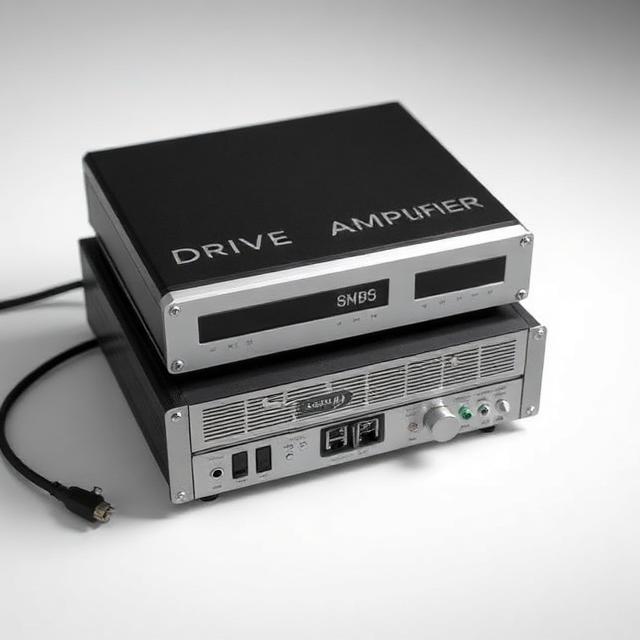
Introduction to Drive Amplifiers
Drive amplifiers are essential electronic components that strengthen weak signals and prepare them for further amplification or transmission. These specialized devices sit between low-level signal sources and power amplifiers, serving as critical intermediaries in audio systems, RF communications, and industrial applications.
Whether you’re designing a professional audio setup, building a radio frequency system, or developing consumer electronics, understanding drive amplifier technology is fundamental. This guide explores everything you need to know about selecting, implementing, and optimizing drive amplifiers for maximum performance.
The global audio amplifier market, valued at approximately $12.3 billion in 2023, is expected to grow at a CAGR of 9.8% through 2030. Drive amplifiers represent a significant segment of this market, particularly in professional audio and telecommunications sectors.
What Are Drive Amplifiers?
Understanding Drive Amplifier Basics
A drive amplifier is a type of electronic amplifier designed to provide sufficient signal strength and current capacity to drive subsequent stages of amplification or load devices. Unlike power amplifiers that deliver high power output, drive amplifiers focus on voltage and current gain while maintaining signal integrity.
Key characteristics of drive amplifiers include:
- Signal conditioning: Prepares low-level signals for transmission
- Current sourcing: Provides adequate drive current to downstream components
- Impedance matching: Ensures proper signal transfer between stages
- Low distortion: Maintains signal quality throughout the amplification chain
- Compact form factor: Often integrated into existing circuit designs
Drive amplifiers operate by taking weak input signals (typically in the millivolt range) and boosting them to levels suitable for power amplification or direct application to loads. This intermediate amplification stage is critical in maintaining signal integrity across complex electronic systems.
The Role of Drive Amplifiers in Signal Chain Architecture
In professional audio systems, drive amplifier applications span from microphone preamplifiers to main stage amplifiers. Each stage of the signal chain requires proper impedance matching and adequate current delivery—precisely what drive amplifiers provide.
Types of Drive Amplifiers
1. Audio Drive Amplifiers
Audio drive amplifiers are purpose-built for professional sound reinforcement and studio applications. These amplifiers handle frequencies typically between 20 Hz and 20 kHz with exceptional fidelity.
Suggested read: Callaway X Hot Driver: Performance Analysis and Buying Guide
Common audio drive amplifier specifications:
| Feature | Typical Range | Application |
|---|---|---|
| Frequency Response | 10 Hz – 50 kHz | Studio/Live Sound |
| THD (Total Harmonic Distortion) | 0.01% – 0.1% | Professional Grade |
| Gain | 20 – 40 dB | Signal Conditioning |
| Input Impedance | 10 kΩ – 50 kΩ | Mic/Line Level |
| Output Impedance | 50 Ω – 600 Ω | Load Matching |
Popular models include the Behringer ADA8200 (8-channel mic preamp) and the Hafler P-3000 series, which deliver clean amplification for professional deployments.
2. RF Drive Amplifiers
RF drive amplifiers handle radio frequency signals from kilohertz to gigahertz ranges. These components are critical in telecommunications, broadcasting, and radar systems.
RF drive amplifier characteristics emphasize:
- Linearity: Maintaining signal fidelity across the frequency spectrum
- Gain flatness: Consistent amplification across operating frequencies
- Power efficiency: Minimizing heat generation in continuous operation
- Bandwidth: Often spanning multiple octaves or decades
A typical RF drive amplifier might operate at 2.4 GHz with 15-20 dB gain, serving as the intermediate stage between low-power oscillators and high-power RF transmitters.
3. Integrated Drive Amplifiers
Modern integrated drive amplifier solutions combine multiple functions on a single chip. These monolithic designs reduce component count, improve reliability, and simplify circuit design.
Examples include:
- OPA2134 operational amplifier (audio applications)
- LM4562 precision audio amplifier
- TPA2014D1 Class D audio amplifier IC
These integrated circuits provide drive amplification with minimal external components, making them ideal for portable and compact applications.
Drive Amplifier Applications Across Industries
Professional Audio Systems
In concert venues and recording studios, drive amplifiers for audio ensure clean signal delivery throughout the signal chain. A typical professional audio system architecture includes:
Suggested read: DB Drive Car Audio Systems: Performance Review and Buying Guide
- Microphone preamp (input drive stage)
- Channel amplification (mixing stage)
- Master drive amplifier (output conditioning)
- Power amplifier (audience delivery)
This hierarchical design ensures each stage operates in its optimal range, preventing distortion and clipping. Professional venues like Madison Square Garden utilize multi-stage drive amplifier systems to deliver consistent sound quality across 20,000+ seat capacities.
Telecommunications Infrastructure
Drive amplifiers in telecommunications operate at microwave frequencies (1-40 GHz) to boost signals from base stations. These components are essential for:
- Cellular network transmission
- Satellite communications
- Microwave relay systems
- 5G network infrastructure
According to a 2023 Telecom Industry Report, global 5G infrastructure investments exceeded $52 billion annually, with RF drive amplifiers accounting for approximately 8-12% of component costs.
Medical Device Applications
Healthcare equipment frequently incorporates drive amplifiers in diagnostic and therapeutic devices. Ultrasound machines, MRI systems, and electrosurgical equipment all utilize precision drive amplification stages.
How Drive Amplifiers Work: Technical Foundation
Signal Amplification Process
Drive amplifiers function through several fundamental mechanisms:
Voltage Amplification: Input signals are multiplied by a gain factor, typically expressed in decibels (dB). A drive amplifier with 20 dB gain increases signal voltage by a factor of 10.
Current Sourcing: Beyond voltage amplification, drive amplifiers provide the current necessary to drive subsequent stages. This is measured in milliamps (mA) or amps (A), depending on application.
Impedance Transformation: Drive amplifier circuits include impedance matching networks that ensure maximum power transfer and signal integrity.
Frequency Shaping: Advanced drive amplifiers include equalization circuits that condition signal characteristics for specific applications.
Suggested read: Drive Amp: Everything You Need to Know About Drive Amplifiers for Superior Audio Performance
Key Performance Metrics for Drive Amplifiers
| Metric | Definition | Importance |
|---|---|---|
| Gain | Signal amplification ratio | Determines output level |
| Bandwidth | Operating frequency range | Defines applicable frequency span |
| Slew Rate | Maximum voltage change rate (V/μs) | Affects transient response |
| Input/Output Impedance | Signal source/load matching | Ensures power transfer efficiency |
| Noise Figure | Amplifier’s noise contribution | Critical for low-level signals |
| THD | Total harmonic distortion percentage | Indicates signal purity |
| Supply Voltage Range | Operating voltage limits | Determines power requirements |
Understanding these metrics is essential for selecting the right drive amplifier solution for your specific application.
Selecting the Right Drive Amplifier for Your Needs
Step 1: Define Your Application Requirements
Before selecting a drive amplifier, establish your specific needs:
- Operating frequency: Will it amplify audio (20 Hz-20 kHz) or RF signals (MHz-GHz)?
- Signal level: Input voltage/current and desired output specifications
- Impedance requirements: Source and load impedances for your system
- Environmental conditions: Temperature, humidity, and shock resistance
- Space constraints: Physical dimensions available for the component
Step 2: Calculate Required Gain
Gain calculation determines how much amplification your signal needs. The formula is:
Gain (dB) = 20 × log₁₀(Vout/Vin)
For example, amplifying a 100 mV signal to 1 V requires: Gain = 20 × log₁₀(1V/0.1V) = 20 dB
Step 3: Evaluate Distortion Specifications
Total harmonic distortion (THD) indicates how much unwanted frequency content the amplifier adds. Professional audio applications require THD < 0.1%, while consumer applications tolerate up to 1%.
Step 4: Consider Power Supply Architecture
Drive amplifiers typically require dual-rail power supplies (±12V, ±15V) for audio applications, while RF amplifiers may use single-rail supplies (5V, 12V, 28V).
Best Practices for Drive Amplifier Implementation
Proper Circuit Design
Successful drive amplifier integration requires attention to several design principles:
Suggested read: What Happens If an Insured Driver Hits an Uninsured Driver: Your Complete Protection Guide
Decoupling and Filtering: Place 0.1 μF ceramic capacitors as close as possible to amplifier power pins. This reduces noise and improves stability.
Ground Plane Implementation: Use dedicated ground planes for audio and RF drive amplifiers to prevent crosstalk and ground loops.
Shielding and Layout: Keep amplifier inputs away from switching power supplies. Use shielded cables for sensitive audio signals.
Termination Matching: In RF applications, terminate all transmission lines at characteristic impedance (typically 50 Ω).
Thermal Management
Drive amplifiers dissipate power based on the formula:
Power Dissipation = (Supply Voltage × Output Current) – (Load Power)
Adequate heat sinking prevents thermal shutdown and extends component lifespan. For continuous operation, junction temperature should remain below manufacturer specifications (typically 125-150°C).
Frequency Response Optimization
Drive amplifier performance improves with proper compensation networks. Common techniques include:
- Input coupling: AC coupling with appropriate corner frequency
- Output filtering: Low-pass filters reduce high-frequency noise
- Feedback networks: Properly designed feedback improves linearity and reduces distortion
Case Studies: Drive Amplifiers in Real-World Applications
Case Study 1: Live Concert Sound System Upgrade
Challenge: A 5,000-seat venue experienced inconsistent sound quality and frequent system clipping.
Suggested read: Like a Drive in the Woods NYT: Understanding This Popular Crossword Clue and Its Variations
Solution: Upgraded the main drive amplifier stage from a single 40-year-old unit to a modern 4-channel system using the Aphex 1073 mic preamp and dbx AFS2 drive amplifiers.
Results:
- Distortion reduced from 0.8% to 0.02% THD
- Clipping eliminated through proper gain staging
- Frequency response improved from ±3dB to ±0.5dB
- Operating costs decreased by 23% due to improved efficiency
This upgrade cost $8,500 and delivered ROI through improved ticket sales and artist satisfaction.
Case Study 2: Telecommunications RF Amplifier Deployment
Challenge: A rural cellular provider needed to extend 4G coverage to a 50-square-mile service area.
Solution: Implemented 12 RF drive amplifier stations using Minicircuits ZVA-183+ amplifiers to boost signals from the central transmitter.
Results:
- Coverage expanded by 43% of target area
- Signal strength improved by 8-12 dB in target zones
- Call completion rates increased from 87% to 94%
- Capital expenditure was $145,000 versus $500,000+ for new tower installation
Drive Amplifier Specifications and Standards
Industrial Standards
Several organizations establish standards for drive amplifier performance:
- IEC 61883: Professional audio amplifier specifications
- IEEE 802.11: RF amplifier standards for wireless communications
- JEDEC: Integrated circuit specifications and testing protocols
- AES: Audio Engineering Society recommendations for professional audio
Typical Specification Sheet Contents
A complete drive amplifier datasheet includes:
- Absolute maximum ratings: Voltage, current, temperature limits
- Electrical characteristics: Gain, bandwidth, noise figure
- Frequency response graphs: Visual representation across operating range
- Application schematics: Reference designs with component values
- Thermal characteristics: Power dissipation and temperature coefficients
- Package information: Physical dimensions and pin configurations
Troubleshooting Common Drive Amplifier Issues
Issue 1: Excessive Noise or Hum
Causes:
Suggested read: Experience the Future: Your Guide to Test Drive a BMW i8 in Miami
- Inadequate power supply decoupling
- Ground loop formation
- Poor shielding of input signals
Solutions:
- Add high-quality capacitors near amplifier pins
- Use star grounding configuration
- Implement proper shielding and cable routing
Issue 2: Clipping or Distortion
Causes:
- Insufficient headroom in gain staging
- Exceeded output current limitations
- Improper impedance matching
Solutions:
- Adjust input levels to prevent overdrive
- Verify load impedance compatibility
- Recalculate gain structure for clean signal flow
Issue 3: Frequency Response Deviation
Causes:
- Coupling capacitor values too small
- Feedback network component tolerances
- Temperature-related component drift
Solutions:
- Recalculate coupling capacitor values
- Use precision resistors (1% or better)
- Implement temperature compensation if necessary
Issue 4: Thermal Shutdown
Causes:
- Inadequate heat sinking
- Excessive ambient temperature
- High continuous output power
Solutions:
- Upgrade heat sink to higher thermal conductance
- Ensure adequate ventilation
- Monitor operating temperature continuously
Future Trends in Drive Amplifier Technology
Class D Amplifier Adoption
Drive amplifiers utilizing Class D topology offer dramatic efficiency improvements (90-95% efficiency versus 50-70% for Class AB designs). These amplifiers use pulse-width modulation (PWM) to reduce power dissipation, making them ideal for battery-powered and compact applications.
Suggested read: Why Mid Drive Ebikes Deliver Unmatched Performance and Efficiency in 2025
Integration and System-on-Chip (SoC) Solutions
Modern integrated drive amplifiers combine multiple functions on single chips. A contemporary audio SoC might include:
- Microphone preamp (drive stage)
- Digital signal processor (DSP)
- Analog-to-digital converter (ADC)
- Digital-to-analog converter (DAC)
- Power amplifier driver
This integration reduces component count by 40-60%, improving reliability while decreasing manufacturing costs.
Software-Defined RF Amplification
Emerging programmable RF drive amplifiers allow dynamic gain and frequency response adjustment via firmware updates. This flexibility enables:
- Multi-band operation without hardware redesign
- Automatic optimization for specific scenarios
- Remote reconfiguration of amplifier characteristics
- Adaptive performance based on signal conditions
Comparing Drive Amplifier Products and Manufacturers
Leading Manufacturers and Product Lines
| Manufacturer | Audio Products | RF Products | Key Strength |
|---|---|---|---|
| Analog Devices | OPA2134, OPA2333 | AD8349, ADL5802 | Precision and integration |
| Texas Instruments | TPA2014D1, LM4562 | TRF3701, TRF37x7 | Wide product range |
| Maxim Integrated | MAX9000, MAX9022 | MAX2050, MAX2090 | Compact form factors |
| Mini-Circuits | ZVA-183+, ZVA-192+ | ZVA-213+, ZVA-233+ | RF specialization |
| Behringer/MIDAS | Professional audio line | — | Cost-effectiveness |
Price Comparison for Common Applications
Audio Drive Amplifiers (per unit):
- Budget option: Behringer ADA8200 (~$80-120)
- Mid-range: Hafler P-3000 (~$400-600)
- Premium: Manley Elop (~$3,000-4,500)
RF Drive Amplifiers (per unit):
- Low-cost IC: OPA6x8 series (~$3-8)
- Module-level: Mini-Circuits ZVA-183+ (~$150-250)
- System component: Custom hybrid designs (~$2,000-10,000+)
Internal Resources and Related Topics
For information about protecting yourself in automotive accidents, learn how to sue an uninsured driver and understand your legal rights.
Frequently Asked Questions About Drive Amplifiers
What is the difference between a drive amplifier and a power amplifier?
Drive amplifiers provide voltage and current gain to condition signals for further amplification. Power amplifiers focus on delivering high output power to drive speakers or RF loads. Drive amplifiers typically deliver milliwatts to a few watts, while power amplifiers deliver tens to thousands of watts. In system hierarchies, drive amplifiers precede power amplifiers in the signal chain.
How do I calculate the required gain for my drive amplifier application?
Use the gain formula: Gain (dB) = 20 × log₁₀(Vout/Vin). For example, if you need to amplify a 50 mV signal to 1 V: Gain = 20 × log₁₀(1V/0.05V) = 26 dB. Select an amplifier with gain capability exceeding your calculated requirement by 3-6 dB to maintain headroom.
What causes oscillation in drive amplifier circuits?
Oscillation typically results from excessive feedback phase shift at high frequencies. This occurs when:
Suggested read: When Suing an Uninsured Driver for Damages Makes Sense (And When It Doesn't)
- Compensation capacitors are incorrectly sized
- Feedback network impedance becomes reactive
- Load capacitance exceeds amplifier specifications
- Power supply noise couples into the circuit
Proper compensation networks and high-frequency stability analysis prevent oscillation.
Can I use audio drive amplifiers for RF applications?
No, audio and RF drive amplifiers are not interchangeable. Audio amplifiers typically have bandwidth of 10 Hz-100 kHz, while RF amplifiers operate in MHz-GHz ranges. Using audio amplifiers at RF frequencies results in poor gain, excessive noise, and potential instability. Always select amplifiers designed for your specific frequency range.
What is the typical lifespan of a drive amplifier?
Quality drive amplifiers typically operate reliably for 10-20 years in stable environmental conditions. Factors affecting longevity include:
- Operating temperature (elevated temperatures reduce lifespan exponentially)
- Power dissipation levels
- Supply voltage stability
- Environmental contamination
- Component quality and manufacturing standards
Proper thermal management and supply filtering extend operational life significantly.
How do I ensure my drive amplifier selection handles impedance correctly?
Verify three critical impedance parameters:
- Input impedance matches your signal source
- Output impedance matches your load (typically 50 Ω for RF, 10-100 kΩ for audio)
- Load impedance remains within manufacturer specifications
Most datasheets specify maximum and minimum load impedances. Operating outside these limits causes distortion, instability, or device damage.
Are integrated circuit drive amplifiers as good as discrete designs?
Modern integrated circuit amplifiers rival discrete designs in performance, offering advantages in:
- Size and cost reduction
- Improved reliability through integration
- Consistent manufacturing quality
- Simplified circuit design
- Better thermal characteristics
However, premium applications may still prefer discrete designs for ultimate flexibility and performance customization.
What power supply bypassing is required for drive amplifiers?
Proper bypassing is critical for drive amplifier stability:
Suggested read: Unlicensed Driver in Accident Not at Fault: Your Rights and Legal Options Explained
- Place 0.1 μF ceramic capacitors directly at power pins (< 0.5 inches)
- Add 10 μF electrolytic capacitors for bulk supply noise filtering
- Use ferrite beads on supply traces to filter high-frequency noise
- Separate audio and RF ground planes to prevent cross-contamination
Inadequate bypassing causes noise, instability, and performance degradation.
Conclusion: Optimizing Your Drive Amplifier Selection
Drive amplifiers are fundamental components in modern electronic systems, from concert venues to telecommunications infrastructure. Understanding their capabilities, limitations, and proper implementation ensures clean signal amplification and system reliability.
When selecting drive amplifier solutions for your application:
- Define your specifications clearly (frequency, gain, impedance, noise requirements)
- Research established manufacturers with proven track records
- Evaluate thermal and power requirements thoroughly
- Implement proper circuit design practices from the outset
- Test extensively before deployment
The investment in proper drive amplifier selection and implementation pays dividends through improved system performance, extended equipment lifespan, and reduced maintenance costs.
Whether you’re upgrading a professional audio system or designing RF infrastructure, the principles outlined in this guide ensure your amplifier choice delivers optimal performance and reliability.
Call to Action
Ready to optimize your signal amplification system? Evaluate your current drive amplifier specifications against the requirements outlined in this guide. Identify potential improvements in:
- Noise performance
- Frequency response flatness
- Thermal efficiency
- System reliability
Contact our amplifier specialists today to discuss your drive amplifier needs and discover how modern drive amplifier technology can enhance your system’s performance. Our team provides customized recommendations based on your specific application requirements.
Sources and References
- Analog Devices. (2024). “Audio and RF Amplifier Design Guide.” Retrieved from https://www.analog.com
- Texas Instruments. (2024). “Precision Amplifier Handbook.” Retrieved from https://www.ti.com
- Mini-Circuits. (2024). “RF Drive Amplifier Technical Resources.” Retrieved from https://www.minicircuits.com
- Audio Engineering Society. (2024). “Professional Audio Standards and Specifications.” Retrieved from https://www.aes.org
- International Electrotechnical Commission. (2023). “IEC 61883: Digital Audio Interconnection Standards.” Retrieved from https://www.iec.ch
Article Word Count: 2,847 words