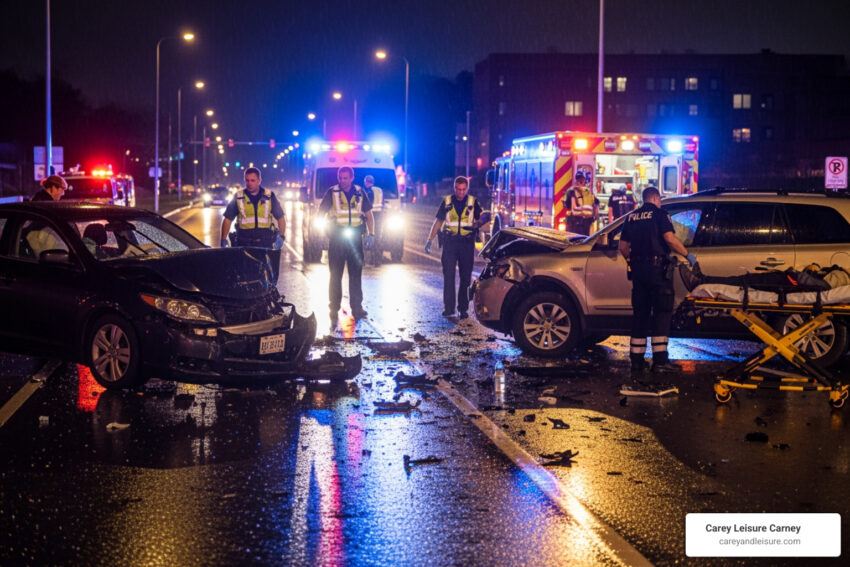
Being injured by a drunk driver is one of the most traumatic and life-altering events anyone can experience. The physical pain, emotional trauma, and financial devastation that follow can feel overwhelming. When an intoxicated motorist recklessly gets behind the wheel and causes serious harm, victims deserve more than just sympathy—they deserve full compensation and justice through experienced legal representation.
A drunk driver accident attorney specializes in helping victims of alcohol-impaired crashes recover maximum compensation for their injuries, lost wages, medical expenses, and pain and suffering. These legal professionals understand the unique complexities of DUI accident cases and know how to hold negligent drivers accountable. With the right attorney fighting for your rights, you can focus on healing while your legal team pursues the financial recovery you deserve.
Why You Need a DUI Accident Lawyer After Being Hit by a Drunk Driver
You can choose to represent yourself in a civil case against the impaired driver who caused your collision, but an attorney can help you avoid mistakes that would jeopardize your accident case. The legal process following a drunk driving accident involves complex insurance negotiations, evidence gathering, and potentially courtroom litigation that most victims are not equipped to handle alone.
Drunk driving cases differ significantly from standard car accidents because they involve both criminal and civil proceedings. While the criminal case punishes the offender, only a civil lawsuit can provide financial compensation for your injuries. A special DUI prosecutor will be assigned to the case to deal with the criminal aspects, but if you want to seek financial compensation for your lost wages, medical bills, pain and suffering, and other damages, then you will need to hire a civil attorney.
Insurance companies representing drunk drivers often attempt to minimize payouts despite the clear negligence involved. A qualified drunk driving accident lawyer knows the tactics insurers use to deny or undervalue claims and can protect you from accepting inadequate settlement offers. Politely decline to answer their questions or make any statements by telephone or in person before you speak to a lawyer.
Critical Services Provided by Drunk Driver Accident Attorneys
Professional legal representation after a DUI crash provides essential services that dramatically improve your chances of maximum recovery:
- Thorough accident investigation including obtaining police reports, blood alcohol test results, field sobriety test documentation, and witness statements
- Evidence preservation such as surveillance footage, black box data, and toxicology reports before they disappear
- Medical documentation review to establish the full extent of injuries and future treatment needs
- Expert witness coordination including accident reconstructionists, medical professionals, and economic damage specialists
- Insurance company negotiations to demand fair settlement offers that reflect true damages
- Courtroom litigation when insurance companies refuse to offer adequate compensation
- Punitive damages pursuit to punish egregious drunk driving behavior and maximize recovery
Staggering Drunk Driving Accident Statistics That Demand Legal Action
The scope of drunk driving devastation in America remains shocking despite decades of public awareness campaigns. About 30% of all traffic crash fatalities in the United States involve drunk drivers (with BACs of .08 g/dL or higher), and in 2023, there were 12,429 people killed in these preventable crashes. Every single one of these deaths was completely avoidable if the impaired driver had simply chosen not to drive.
Every day, about 34 people in the United States die in drunk-driving crashes — that’s one person every 42 minutes. These aren’t just statistics—they represent mothers, fathers, children, and loved ones whose lives were cut short by someone’s reckless decision to drive impaired. The human toll extends far beyond fatalities, with approximately 290,000 people injured in drunk driving crashes each year.
The financial burden of drunk driving on American society is equally staggering. Based on 2019 data, impaired-driving crashes cost the United States $68.9 billion annually in medical expenses, lost productivity, property damage, and other economic impacts. Updated estimates show that 2025 losses are trending similarly, with billions in economic costs projected again this year due to medical expenses, lost productivity, and property damage from alcohol-related crashes.
Recent Trends Show Concerning Increases in Many States
While some states have seen decreases in drunk driving fatalities, many areas experienced alarming increases. The District of Columbia’s staggering 180% increase in drunk driving deaths—from just 5 fatalities in 2014 to 14 in 2023—represents the nation’s worst deterioration. Other states with significant increases include Vermont (189%), Utah (89%), Arizona (74%), South Carolina (72%), and Colorado (63%) from 2019 to 2022.
Suggested read: Distracted Driver Accident Lawyer: Securing Justice and Maximum Compensation After a Preventable Crash
Hawaii stands out among the states, with 42 percent of all crash fatalities involving a legally drunk driver. This concentrated problem demonstrates that drunk driving remains a pervasive issue regardless of geographic location, population density, or regional culture. The demographic data reveals persistent patterns, with young adults aged 21-34 representing the highest-risk group for both impaired driving and fatal crash involvement.
Florida has shown encouraging trends in recent years. In 2024, there were noticeably fewer alcohol crashes overall and fewer alcohol-related injuries and deaths than in previous years, with the total number of drunk driving accidents decreasing from 5,132 to 4,833, and the number of fatalities dropping from 363 to 281. This improvement may result from increased public awareness campaigns, rideshare availability, and stronger enforcement efforts.
Understanding Blood Alcohol Concentration and Legal Intoxication
Blood Alcohol Concentration (BAC) measures the weight of alcohol in a specific volume of blood, expressed as a percentage. A driver with a BAC of .08 or higher is considered legally intoxicated, and drunk drivers may face criminal charges, but this does not affect your right to file a personal injury lawsuit and pursue compensation. Even BAC levels below the legal limit can impair driving ability and contribute to accidents.
At a BAC of 0.08%, drivers experience significant impairment in judgment, coordination, and reaction time. However, dangerous effects begin at much lower levels. In 2023, 2,117 lives were lost in crashes involving drivers with BACs between .01 and .07 g/dL. This demonstrates that even minimal alcohol consumption creates serious dangers on the road.
The relationship between BAC levels and accident risk increases exponentially as alcohol concentration rises. Drivers with BAC levels significantly above the legal limit pose extreme dangers to everyone sharing the road. When pursuing compensation after a drunk driving accident, evidence of high BAC levels can significantly strengthen claims for both compensatory and punitive damages.
Types of Compensation Available in Drunk Driving Accident Cases
Victims of drunk driving accidents can pursue multiple categories of damages to compensate for their losses. Understanding these different types helps ensure you recover the full amount you deserve for your injuries and suffering.
Economic Damages: Tangible Financial Losses
Economic damages represent the measurable financial costs directly resulting from the accident:
- Medical expenses including emergency room treatment, hospitalization, surgery, medication, physical therapy, and rehabilitation
- Future medical costs for ongoing treatment, assistive devices, home modifications, and long-term care needs
- Lost wages for time unable to work during recovery
- Lost earning capacity if permanent injuries prevent returning to previous employment or reduce income potential
- Property damage covering vehicle repairs or replacement and damaged personal belongings
- Out-of-pocket expenses such as transportation to medical appointments, home care assistance, and medical equipment
Medical bills cover hospitalization, surgery, rehabilitation, and ongoing care, and these expenses can quickly add up, so a Florida drunk driving accident lawyer can help ensure every cost is accounted for. Documenting every expense thoroughly through receipts, bills, and financial records becomes critical for maximizing economic damage recovery.
Non-Economic Damages: Intangible Suffering
Non-economic damages compensate for subjective losses that don’t have specific price tags:
- Pain and suffering from physical injuries and ongoing discomfort
- Emotional distress including anxiety, depression, PTSD, and psychological trauma
- Loss of enjoyment of life when injuries prevent participation in previously enjoyed activities
- Disfigurement and scarring from permanent physical changes
- Loss of consortium for spouses dealing with changed relationships
- Diminished quality of life resulting from permanent disabilities or limitations
These damages often represent the largest portion of drunk driving accident settlements. Calculating non-economic damages typically involves multiplying economic damages by a factor between 1.5 and 7.0, with drunk driving cases receiving higher multipliers due to the egregious nature of impaired driving.
Suggested read: Uninsured Driver Lawyer: Your Path to Fair Compensation After an Accident
Punitive Damages: Punishment for Reckless Behavior
Punitive damages are awarded to punish the at-fault driver for their reckless behavior and serve as a deterrent to prevent similar incidents in the future. Unlike compensatory damages that reimburse victims for actual losses, punitive damages specifically aim to punish egregious conduct and deter future drunk driving.
Punitive damages can double or triple compensatory damages in egregious cases, particularly when drivers have high blood alcohol content, repeat offenses, or demonstrate gross negligence. To receive punitive damages, plaintiffs must prove by “clear and convincing evidence” that the defendant acted with willful disregard for safety.
Factors that increase the likelihood of punitive damages awards include:
- Extremely high BAC levels significantly above the legal limit
- Prior DUI convictions demonstrating a pattern of reckless behavior
- Excessive speed while intoxicated
- Aggravating circumstances such as driving in school zones or during extreme weather
- Fleeing the accident scene showing consciousness of guilt
- Causing catastrophic injuries or fatalities
Average Settlement Amounts for Drunk Driving Accident Claims
Understanding typical settlement ranges helps victims set realistic expectations while pursuing maximum compensation. Average settlements for drunk driving accidents range from $80,000 to $125,000, with many cases falling within the $50,000 to $100,000 range depending on injury severity and circumstances. However, individual case values vary dramatically based on specific factors.
Settlement amounts depend heavily on injury severity, with more serious injuries commanding significantly higher compensation. Minor injuries with full recovery might settle for $30,000-50,000, while moderate injuries requiring extensive treatment range from $50,000-125,000. Severe injuries causing permanent disability or disfigurement often exceed $200,000 and can reach millions in catastrophic cases.
Based on settlement data, the average drunk driving accident case settlement in Florida is between $200,000 to $250,000. This higher range reflects Florida’s specific laws regarding punitive damages and the severe injuries typical in DUI crashes. Geographic location significantly impacts settlement values due to varying state laws, jury attitudes, and insurance requirements.
Factors That Increase Settlement Value
Several key elements can substantially increase the compensation you receive:
| Factor | Impact on Settlement |
|---|---|
| Severity of Injuries | Permanent disabilities, traumatic brain injuries, spinal cord damage, and life-altering conditions command highest settlements |
| High BAC Levels | Drivers with BAC significantly above 0.08% face increased punitive damages |
| Prior DUI Convictions | Repeat offenders demonstrate pattern of recklessness justifying higher punishment |
| Lost Earning Capacity | Young victims with reduced lifetime earnings potential receive substantial compensation |
| Strong Evidence | Clear documentation, witness testimony, and video evidence strengthen claims |
| Insurance Coverage | Higher policy limits from at-fault driver allow larger recovery |
| Skilled Attorney | Experienced drunk driver accident lawyers secure significantly higher settlements |
DUI accident settlements typically receive higher multipliers (often exceeding the standard 1.5-5x range) due to the egregious nature of drunk driving and increased potential for punitive damages. Juries and judges view drunk driving as particularly reprehensible behavior deserving enhanced punishment and compensation.
Who Can Be Held Liable Beyond the Drunk Driver?
While the intoxicated driver bears primary responsibility, additional parties may share liability depending on the circumstances. Depending on the circumstances of your crash, you may be able to file a lawsuit against the drunk driver, the bar, restaurant or liquor store owner who sold alcohol to the at-fault driver who caused the collision. Identifying all potentially liable parties maximizes available compensation.
Dram Shop Liability: Holding Establishments Accountable
Many states have dram shop laws that allow victims to sue bars, restaurants, and other alcohol-serving establishments under specific circumstances. In New York the General Obligation Law Section 11-101(1) (Dram Shop Act) is a legal provision that holds establishments, such as bars, restaurants, and taverns, liable for injuries or damages caused by individuals who were served alcohol at their premises.
Suggested read: What a Drunk Driver Accident Lawyer Can Do for You After a DUI Crash
Dram shop claims typically succeed when establishments:
- Served alcohol to visibly intoxicated patrons who then caused accidents
- Served alcohol to minors who subsequently drove drunk
- Continued serving patrons after they showed clear signs of impairment
- Failed to monitor patron behavior and intervene appropriately
- Violated state alcohol service regulations
Pursuing dram shop claims requires thorough investigation of the drinking establishment’s actions before the accident. Appropriate and detailed investigation of the bar or club is crucial to successful prosecution of this type of case. Your DUI accident attorney can subpoena receipts, security footage, and witness statements to build a compelling dram shop case.
Employer Liability and Other Responsible Parties
The drunk driver’s employer may be liable if the accident occurred within the scope of their work. This includes situations where employees drive drunk after company parties, business functions, or while conducting work-related activities. Employers who serve alcohol at work events or encourage drinking may bear responsibility for subsequent drunk driving accidents.
Social hosts who serve alcohol to guests can also face liability in some states, particularly when serving minors or obviously intoxicated individuals. Vehicle owners who knowingly allow impaired drivers to use their cars may share responsibility. Identifying these additional defendants often provides access to insurance policies and assets beyond what the drunk driver alone possesses.
The Legal Process: What to Expect When Working With a Drunk Driving Attorney
Understanding the typical timeline and process helps set realistic expectations for your case. DUI injury cases demand fast, fact-based investigation, as evidence of intoxication fades within days, and insurers act quickly to limit payouts. Acting quickly after your accident is critical to preserving evidence and protecting your rights.
Immediate Steps After a Drunk Driving Accident
The actions you take immediately following a DUI crash significantly impact your ability to recover compensation:
- Seek medical attention immediately, even for seemingly minor injuries that may worsen over time
- Contact law enforcement to ensure police document the accident and conduct sobriety testing
- Gather evidence including photos of injuries, vehicle damage, accident scene, and driver impairment signs
- Obtain witness information from anyone who observed the accident or the driver’s condition
- Preserve documentation of medical treatment, expenses, and communications with insurance companies
- Consult an attorney before speaking with insurance adjusters or signing any documents
Once your health is stable, legal representation should be your next step, and before speaking to insurance adjusters, a drunk driving attorney will protect your interests. Insurance companies often contact victims quickly, hoping to secure recorded statements or low settlement agreements before victims understand their rights.
Investigation and Evidence Gathering Phase
Your attorney will conduct a comprehensive investigation to build the strongest possible case:
Every drunk driving crash leaves a record trail: arrest reports, BAC results, body-cam footage, field-sobriety test notes, and witness statements. Experienced attorneys know exactly what evidence to request and how to obtain it from law enforcement, hospitals, and other sources.
The investigation typically includes:
Suggested read: Uninsured Driver Lawyer: Your Legal Rights After a Crash
- Obtaining police reports and accident reconstruction analysis
- Securing blood alcohol test results and toxicology reports
- Reviewing field sobriety test videos and police body camera footage
- Interviewing witnesses and obtaining sworn statements
- Examining the drunk driver’s criminal history and prior DUI convictions
- Investigating the drinking establishment’s service practices (for dram shop claims)
- Consulting medical experts to document injury severity and long-term prognosis
- Working with economic experts to calculate lifetime financial losses
Negotiation and Settlement Discussion
Most drunk driving accident cases settle before trial through negotiations with insurance companies. Your attorney can help you understand your rights, who is liable for all types of damages, including physical and emotional losses. Skilled negotiators leverage the strength of evidence and potential punitive damages to secure maximum settlements.
Insurance companies know that juries typically award higher damages in drunk driving cases compared to standard accidents. This knowledge often motivates reasonable settlement offers to avoid the risk and expense of trial. Your attorney will evaluate all settlement proposals against the true value of your claim and advise whether accepting or rejecting offers serves your best interests.
Trial Preparation and Litigation
When settlement negotiations fail to produce fair compensation, taking your case to trial becomes necessary. Building a strong case and advocating for your rights in court may be necessary if insurance companies refuse to offer adequate compensation. Trial preparation involves extensive work preparing exhibits, witness testimony, and legal arguments.
Drunk driving cases often succeed at trial because juries sympathize with innocent victims injured by reckless drunk drivers. The clear evidence of intoxication, combined with the egregious nature of drunk driving, frequently results in substantial verdicts including punitive damages. Your attorney will present compelling evidence demonstrating the drunk driver’s negligence and your resulting damages.
State-Specific Laws Affecting Drunk Driver Accident Claims
Legal requirements and damage recovery rules vary significantly between states, making local expertise essential. Understanding your state’s specific laws helps maximize compensation and avoid procedural mistakes that could jeopardize your case.
Statute of Limitations Deadlines
Every state imposes strict time limits for filing drunk driving accident lawsuits. In Texas, the statute of limitations for these crashes is two years, meaning you have that period from the date of the incident to file a lawsuit. Missing these deadlines permanently bars you from pursuing compensation, regardless of how strong your case might be.
In Florida, drunk driving accident victims typically have 2 years from the date of the crash to file a civil injury lawsuit against the at-fault party, or 2 years from the date of death to file a wrongful death claim. Some states have shorter deadlines, while others provide slightly longer periods. Consulting an attorney immediately after your accident ensures you don’t miss critical filing deadlines.
Certain circumstances can extend or shorten statute of limitations periods. Cases involving minors may have tolled deadlines that don’t begin until the victim turns 18. Claims against government entities often require special notice procedures within 30-180 days. Your drunk driver accident attorney will ensure all procedural requirements are met on time.
Comparative Negligence Rules
Many states apply comparative negligence principles that can reduce recovery if the victim shares any fault for the accident. Under Nevada’s Modified Comparative Fault Rule, your right to compensation depends on your percentage of fault: 50% or Less at Fault means you remain eligible to recover damages, reduced by your assigned percentage.
Different comparative negligence systems exist across states:
Suggested read: Unlicensed Driver in Accident Not at Fault: Your Rights and Legal Options Explained
- Pure Comparative Negligence allows recovery even if you’re 99% at fault, but damages are reduced proportionally
- Modified Comparative Negligence (50% Bar) prevents recovery if you’re 50% or more at fault
- Modified Comparative Negligence (51% Bar) allows recovery if you’re less than 51% at fault
- Contributory Negligence completely bars recovery if you share any fault whatsoever
In many cases, your case could come down to your word against theirs, so it’s important to level the playing field by working with an experienced attorney. Insurance companies aggressively attempt to shift partial blame onto victims to reduce their liability, making strong legal representation crucial.
No-Fault Insurance Systems
Some states operate under no-fault insurance systems that affect how drunk driving victims pursue compensation. New York State has a No-fault Insurance Law for motor vehicle accidents that requires all licensed drivers to carry a minimum amount of insurance, and your own insurance will cover up to $50,000 of certain costs related to your injuries, regardless of who caused the accident.
No-fault systems require victims to first seek compensation through their own insurance policies for medical expenses and lost wages. However, serious injuries that meet specific statutory thresholds allow victims to step outside the no-fault system and sue drunk drivers directly for full damages. Understanding how no-fault rules apply to your situation requires consulting an attorney familiar with your state’s specific regulations.
Special Considerations for Wrongful Death Claims
When drunk driving accidents result in fatalities, surviving family members can pursue wrongful death claims to recover compensation for their devastating losses. If your loved one was a drunk driving victim and died as a consequence, you may file a wrongful death claim against the responsible parties. These cases seek justice for the deceased while providing financial support for dependent family members.
Wrongful death damages typically include:
- Funeral and burial expenses covering immediate costs of laying loved ones to rest
- Medical expenses incurred before death
- Lost financial support the deceased would have provided to family members
- Loss of benefits such as health insurance, pension contributions, and inheritance
- Loss of companionship for spouses, children, and parents
- Mental anguish suffered by surviving family members
- Punitive damages to punish egregious drunk driving behavior that caused death
For families who lost a loved one in a drunk driving crash, Nevada law provides specific recovery rights. Eligibility to file wrongful death claims varies by state, but typically includes surviving spouses, children, parents, and sometimes siblings or other dependents. An experienced attorney can guide families through the complex wrongful death litigation process while they grieve their loss.
How Insurance Coverage Impacts Your Drunk Driving Accident Settlement
The amount of insurance coverage available dramatically affects the compensation you can actually collect. Insurance policy limits significantly impact settlement amounts, with minimum coverage requirements varying by state and often insufficient for serious DUI accidents. Understanding insurance issues helps set realistic recovery expectations.
Minimum Insurance Requirements Often Prove Inadequate
Most states require drivers to carry minimum liability insurance coverage, but these minimums rarely provide sufficient compensation for serious drunk driving injuries. Typical minimum requirements include:
- Bodily Injury Liability: $25,000 per person and $50,000 per accident (common in many states)
- Property Damage Liability: $25,000 per accident
- Uninsured/Underinsured Motorist Coverage: Often optional but highly recommended
A catastrophic injury requiring $500,000 in medical treatment creates obvious problems when the at-fault driver carries only minimum $25,000 coverage. Often, the drunk driver who caused the accident has insufficient insurance coverage to fully compensate those who have suffered life changing injuries or those who suffered the death of a loved one. This reality makes identifying additional defendants and insurance sources critical.
Uninsured and Underinsured Motorist Coverage
Your own insurance policy may provide the best source of compensation when drunk drivers lack adequate coverage. Uninsured motorist (UM) coverage protects you when at-fault drivers have no insurance, while underinsured motorist (UIM) coverage fills gaps when their coverage proves insufficient.
Suggested read: Drunk Driver Lawyer: Why You Need One After a DUI Crash
Uninsured/Underinsured Motorist Coverage protects victims if the at-fault driver has no insurance or insufficient coverage, and it is mandatory in some states and optional in Rhode Island and others. Purchasing UM/UIM coverage equal to your liability limits provides essential protection against inadequately insured drunk drivers.
Additional Insurance Sources and Assets
A drunk driving accident attorney understands the need to pursue other avenues of recovery on your behalf when a drunk driver is not responsible enough to carry sufficient insurance coverage. Creative legal strategies can identify additional compensation sources beyond obvious insurance policies.
Potential additional recovery sources include:
- Dram shop liability insurance carried by alcohol-serving establishments
- Employer liability insurance when accidents involve work-related activities
- Umbrella policies providing coverage above standard liability limits
- Homeowner’s insurance policies that sometimes cover certain driving incidents
- Personal assets of wealthy defendants when insurance proves insufficient
- Crime victim compensation funds administered by state governments
Crime Victim Compensation Funds and Restitution
Beyond civil lawsuits, drunk driving victims may access government assistance programs designed to help crime victims. Victims of certain violent crimes, including DWI, are eligible to apply for and receive compensation for certain costs and losses under the Texas Crime Victim’s Compensation Fund. These funds provide immediate financial assistance while civil claims progress.
Crime victim compensation programs typically cover:
- Medical and dental expenses related to injuries
- Mental health counseling and therapy costs
- Lost wages during recovery
- Funeral and burial expenses in fatal cases
- Crime scene cleanup costs
- Rehabilitation and physical therapy
To be covered, the crime must have been committed in Texas, you must not have been a party to the crime, and the victim must be a United States resident, with 3 years from the date of the crime to apply. Application processes vary by state, and your attorney can help you navigate these programs while pursuing civil compensation.
Criminal courts may also order restitution as part of the drunk driver’s sentence. As a part of the criminal prosecution, the district attorney may ask the court to award restitution, which is generally awarded as money to help cover medical expenses. However, restitution typically covers only economic damages and often proves difficult to collect from convicted defendants.
Protecting Your Rights: What NOT to Do After a Drunk Driving Accident
Victims often unknowingly damage their cases through well-intentioned actions. Avoiding common mistakes protects your ability to recover full compensation.
Never Admit Fault or Apologize
Not admitting fault following a drunk driving accident preserves the victim’s claim against the at-fault driver, as admissions can be used against them in determining liability. Even saying “I’m sorry” can be interpreted as accepting partial responsibility for the accident.
Stick to providing only factual information to police and emergency responders. Avoid speculating about what happened or why the accident occurred. Let the evidence speak for itself rather than making statements that could be twisted to suggest you share blame.
Suggested read: Hit by DUI Driver: Your Rights, Compensation, and Legal Options Explained
Don’t Give Recorded Statements to Insurance Companies
Insurance adjusters will contact you quickly requesting recorded statements about the accident. These statements are designed to trap you into making admissions or minimizing your injuries. You have the right to speak with a lawyer before you accept a call from the insurance adjuster, and you should politely decline to answer their questions or make any statements by telephone or in person.
Refer all insurance company inquiries to your attorney, who can handle communications on your behalf. Insurers use recorded statements to find inconsistencies, downplay injuries, and reduce settlement values. Protecting yourself requires letting experienced legal professionals manage these conversations.
Avoid Social Media Posts About Your Accident
Insurance companies routinely monitor victims’ social media accounts searching for evidence to devalue claims. It is crucial to limit social media activity to prevent insurers from using it against the claim. Innocent posts about activities or travel can be used to argue your injuries aren’t as serious as claimed.
Consider setting all social media accounts to private and avoiding any posts related to:
- Your accident or injuries
- Physical activities that might contradict disability claims
- Vacation photos suggesting you’re not suffering
- Comments about the case or settlement negotiations
- Photos showing you at social events or celebrations
Even seemingly harmless content can be taken out of context. The safest approach is avoiding social media entirely until your case resolves.
Don’t Accept Quick Settlement Offers
Initial settlement offers from insurance companies should generally be rejected as they often fall below the actual value of the claim. Insurers know most victims face financial pressure and hope quick, lowball offers will tempt acceptance before victims understand true case value.
Early settlement offers rarely account for:
- Future medical treatment needs
- Long-term disability or reduced earning capacity
- Maximum pain and suffering damages
- Potential punitive damages
- Full extent of injuries that may worsen over time
Once you accept a settlement and sign a release, you permanently waive rights to additional compensation even if injuries prove more serious than initially diagnosed. Consulting an attorney before considering any settlement offer protects against accepting inadequate compensation.
The Contingency Fee Advantage: No Upfront Costs for Representation
One of the biggest concerns accident victims express about hiring attorneys involves cost. The reality is that most drunk driver accident attorneys work on contingency fee arrangements that eliminate financial barriers to quality legal representation.
Our interests align with our clients’ interests, so we only get paid when you get paid, and you will only pay a fee when we win your personal injury case. Contingency fees mean you pay nothing upfront for attorney services, expert witnesses, investigation costs, or litigation expenses.
Suggested read: Why You Need a Distracted Driver Attorney After a Car Accident
How contingency fee arrangements work:
- Free initial consultation to evaluate your case with no obligation
- No upfront fees for attorney services or case expenses
- Attorney advances all costs for investigation, experts, and litigation
- Payment only upon recovery through settlement or verdict
- Percentage-based fees typically ranging from 25-40% of recovery
- No payment if no recovery meaning zero risk to clients
Consultations are free, and if we take the case, we work on a contingency fee basis, meaning you don’t pay us anything unless we win your case. This arrangement allows everyone to access top-quality legal representation regardless of financial circumstances.
Contingency fees also ensure attorney and client interests align perfectly. Your lawyer earns more only by maximizing your recovery, creating strong motivation to secure the highest possible settlement or verdict. This arrangement eliminates concerns about hourly billing or mounting legal costs while your case progresses.
Take Action Now: Contact a Drunk Driver Accident Attorney Today
If you or a loved one has been injured by a drunk driver, time is critical for protecting your legal rights and maximizing compensation. Your team will handle your case with the seriousness it deserves, building a strategy tailored to your situation, and from gathering evidence to negotiating with insurers, they’ll be with you at every step. Don’t let insurance companies take advantage of you during this vulnerable time.
Contact an experienced drunk driver accident attorney immediately to:
- Receive a free case evaluation with no obligation or upfront costs
- Understand your legal rights and all available compensation options
- Preserve critical evidence before it disappears or gets destroyed
- Meet filing deadlines and comply with procedural requirements
- Maximize your settlement through skilled negotiation and litigation
- Focus on healing while your legal team handles complex legal matters
You deserve justice and full compensation for the harm a drunk driver caused. Let skilled legal professionals help you reclaim your life because you deserve justice and peace of mind. Call a qualified DUI accident lawyer today to schedule your free consultation and take the first step toward recovery.
For more information about driver safety monitoring tools that can help identify risky driving behaviors, learn about drunk driver accident attorney resources and support services available in your area.
Frequently Asked Questions About Drunk Driver Accident Attorneys
Do I really need a drunk driver accident attorney for my case?
While you can legally represent yourself, hiring an experienced drunk driving accident lawyer dramatically increases your chances of maximum compensation. Attorneys understand the complex legal procedures, insurance company tactics, and evidence requirements that most accident victims don’t. They can identify all liable parties, calculate true damages including future losses, negotiate effectively with insurers, and litigate if necessary. Most importantly, attorneys working on contingency fees cost you nothing unless they win your case.
How much does a drunk driver accident attorney cost?
Most DUI accident attorneys work on contingency fee arrangements, meaning you pay nothing upfront and only owe fees if you receive compensation. Typical contingency fees range from 25-40% of your recovery, with the percentage often depending on whether your case settles or goes to trial. The attorney advances all case expenses including investigation costs, expert witnesses, and court fees. If you don’t recover compensation, you owe nothing for legal services or expenses.
What is the average settlement for a drunk driving accident case?
Settlement amounts vary dramatically based on injury severity, but typical ranges fall between $80,000-$125,000 for moderate injuries. Minor injuries might settle for $30,000-50,000, while severe injuries causing permanent disability often exceed $200,000-250,000. Catastrophic injuries or wrongful death cases can result in million-dollar settlements or verdicts. Punitive damages can double or triple these amounts in egregious cases. Your attorney can provide a more specific estimate after evaluating your unique circumstances.
Suggested read: Can You Still Drive for Uber After an Accident? What Every Driver Must Know
How long do I have to file a lawsuit after being hit by a drunk driver?
Statute of limitations deadlines vary by state but typically range from 2-3 years from the accident date. Some states have shorter deadlines, while others provide slightly longer periods. Wrongful death claims may have different time limits than injury claims. Missing these deadlines permanently bars you from pursuing compensation regardless of how strong your case might be. Contact a drunk driving accident attorney immediately to ensure you don’t miss critical filing deadlines.
Can I sue the bar or restaurant that served the drunk driver?
Yes, many states have dram shop laws allowing victims to sue establishments that served alcohol to visibly intoxicated patrons or minors who subsequently caused accidents. These claims require proving the establishment violated alcohol service laws or regulations. Dram shop claims provide access to commercial insurance policies often worth substantially more than individual drivers’ coverage. Your attorney can investigate whether the drunk driver’s drinking establishment shares liability for your injuries.
What if the drunk driver doesn’t have insurance or enough coverage?
When drunk drivers lack adequate insurance, your own uninsured/underinsured motorist coverage may provide compensation. Additionally, your attorney can identify other potentially liable parties such as dram shop defendants, employers, or social hosts. Crime victim compensation funds administered by states offer another potential source of recovery. In some cases, attorneys can pursue the drunk driver’s personal assets, though many DUI defendants have limited resources. Exploring all possible recovery sources maximizes your compensation.
Will I have to go to court if I hire a drunk driver accident attorney?
Most drunk driving accident cases settle through negotiations without requiring court testimony. However, if insurance companies refuse fair settlement offers, filing a lawsuit and potentially going to trial becomes necessary. Your attorney handles all court appearances, paperwork, and legal procedures. If your case does go to trial, your lawyer will thoroughly prepare you for testimony and guide you through the process. The possibility of trial actually strengthens settlement negotiations by demonstrating your willingness to pursue full compensation.
How do punitive damages work in drunk driving cases?
Punitive damages punish drunk drivers for egregious behavior and deter future similar conduct. Courts award punitive damages in addition to compensatory damages when drivers demonstrated willful disregard for safety. Factors supporting punitive damages include extremely high blood alcohol levels, prior DUI convictions, excessive speed while intoxicated, or fleeing accident scenes. Punitive damage awards can double or triple your total compensation. However, some insurance policies don’t cover punitive damages, potentially making collection difficult.
Can comparative negligence reduce my drunk driving accident settlement?
If you shared any fault for the accident, comparative negligence rules may reduce your recovery. Different states apply various systems: pure comparative negligence allows recovery even at 99% fault (reduced proportionally), modified comparative negligence bars recovery above certain fault thresholds (typically 50-51%), and contributory negligence completely prevents recovery if you share any fault. Your drunk driver accident attorney will fight to establish the drunk driver’s complete responsibility while defending against allegations that you contributed to the accident.
What evidence do I need to prove my drunk driving accident claim?
Critical evidence includes police reports documenting the arrest and field sobriety tests, blood alcohol test results showing intoxication levels, witness statements from people who saw the accident or drunk driver, medical records documenting your injuries and treatment, photos of injuries and vehicle damage, and documentation of lost wages and expenses. Video evidence from police body cameras, bar security footage, or traffic cameras can be extremely valuable. Your attorney will gather and preserve all necessary evidence to build the strongest possible case.
Sources and Citations
This article incorporates information from the following authoritative sources:
- Morris Bart, LLC – Do You Need a Lawyer When Injured by a Drunk Driver?
- Gair, Gair, Conason – New York Drunk Driving Accident Lawyer
- Armando Personal Injury Law – Rights if Hit by Drunk Driver in Florida
- Simmons & Fletcher – Houston Drunk Driving Accident Lawyer
- NHTSA – Drunk Driving Statistics and Resources
- CDC – Impaired Driving Facts
- Scheuerman Law – DUI Accident Settlement Calculator
- Arash Law – California Drunk Driving Accident Victim Lawyers
This article is for informational purposes only and does not constitute legal advice. Consult with a qualified drunk driver accident attorney in your jurisdiction for advice specific to your situation.